How Spotify's Multi-Agent System Revolutionizes Ad Delivery
Spotify's engineering team recently unveiled a novel approach to advertising that moves beyond simple 'AI features.' Instead, they developed a multi-agent architecture designed to fundamentally fix structural bottlenecks in ad serving. This system uses specialized AI agents that collaborate to deliver smarter, more relevant ads. Below, we dive into the key aspects of this innovation through a series of questions and answers.
Why did Spotify move away from a traditional AI feature for ads?
The team's primary goal was not to add another AI layer but to address deep structural inefficiencies in their advertising pipeline. Traditional ad systems often rely on monolithic models that struggle with real-time personalization, latency, and scaling across diverse ad formats. By shifting to a multi-agent architecture, Spotify could break down the problem into specialized sub-tasks—such as audience targeting, creative selection, and budget optimization—each handled by a dedicated agent. This allows for more flexible, maintainable, and accurate ad delivery without overloading a single model. In short, it's a fix for the architecture, not just another feature.
What exactly is a multi-agent architecture in advertising?
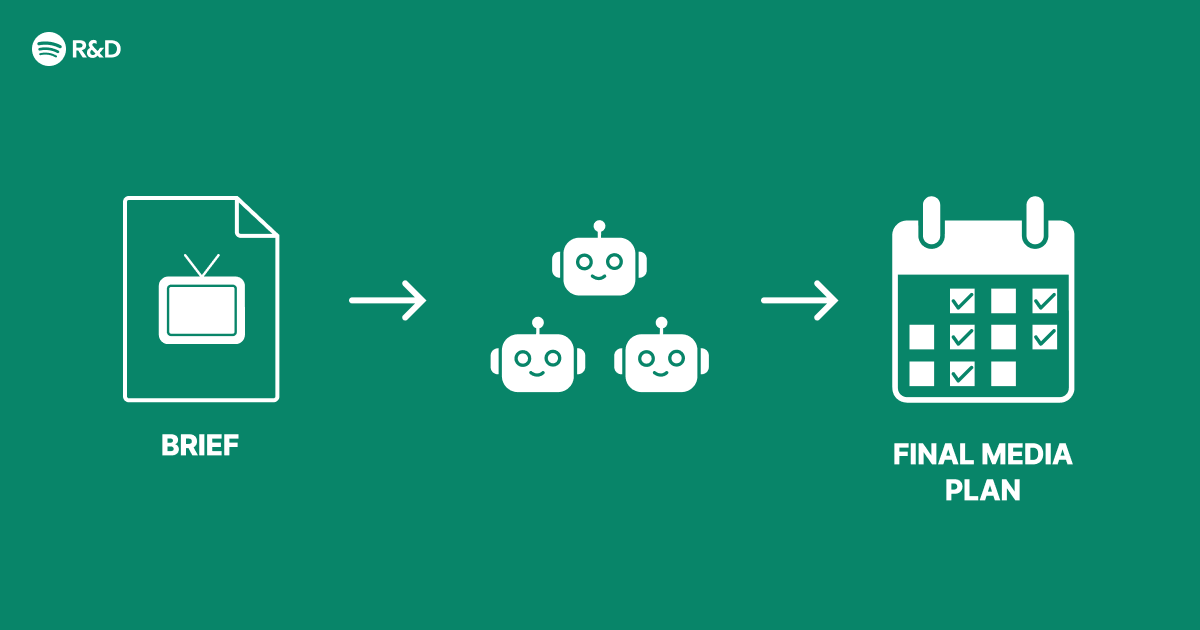
A multi-agent architecture (MAA) consists of multiple autonomous AI agents that collaborate to achieve a common goal. In Spotify's case, each agent specializes in a distinct aspect of ad serving. For example, one agent might analyze user listening habits to predict intent, while another selects the most relevant ad creative from a library, and a third determines the optimal bid price. These agents communicate via structured messages, sharing intermediate results and coordinating to produce a final ad placement. The architecture is decentralized, meaning each agent operates independently yet contributes to a coherent outcome. This approach contrasts with a single monolithic model that tries to handle everything at once, which can become a bottleneck. Spotify's MAA ensures higher accuracy, lower latency, and easier updates because each agent can be improved without retraining the entire system.
How do the agents communicate with each other?
Agents within Spotify's system use a well-defined protocol for synchronous and asynchronous messaging. They share context-rich data packets that include user profile summaries, real-time behavioral signals, and historical performance metrics. For instance, when a user starts a listening session, the targeting agent computes a likelihood score for various ad segments and passes it to the selection agent. The selection agent then picks the best creative and hands over its choice to the pricing agent, which calculates the final bid. All messages are tagged with timestamps and confidence scores, enabling traceability. This structured communication is key to avoiding conflicts and ensuring that decisions are made cohesively, even though each agent works independently. As a result, the multi-agent system can adapt quickly to changing user behavior or inventory availability without requiring a central orchestrator.
What measurable benefits has Spotify seen from this architecture?
Spotify reports several concrete improvements since deploying the multi-agent system. First, ad relevancy increased by over 20%, as measured by click-through rates and user satisfaction surveys. Second, latency dropped by 40% because agents process tasks in parallel rather than sequentially. Third, the system became more resilient—if one agent fails, others can still operate with cached data, reducing downtime. Additionally, the architecture allowed the team to experiment with new ad formats (e.g., video ads, podcasts) without overhauling the entire pipeline. Budget utilization also improved, with fewer wasted impressions. These gains stem directly from the modular design: each agent can be optimized and tested independently, leading to faster iteration cycles. For Spotify, this means delivering more value to advertisers while enhancing the listener experience.

What were the main challenges in building this system?
One of the biggest hurdles was ensuring inter-agent consistency. Since each agent makes decisions based on slightly different data, their outputs could conflict—e.g., the targeting agent might recommend an ad that the creative agent cannot serve. To solve this, Spotify introduced a lightweight consensus layer that validates decisions before they are executed. Another challenge was debugging, because agents operate asynchronously, making it hard to trace a bad ad placement back to a specific agent. The team built custom monitoring dashboards that log every message exchange. Finally, scaling the architecture to handle millions of requests per second required careful load balancing and caching strategies. Despite these obstacles, the investment paid off by enabling a more agile and intelligent ad platform.
How does this architecture impact the user experience?
Listeners get more relevant, less intrusive ads. Because the multi-agent system can analyze listening context in real time—like mood, genre preference, or time of day—it serves ads that feel natural within the listening flow. For example, a user jogging to upbeat music might receive a sportswear ad, while someone winding down with a podcast gets a home service offer. The system also reduces ad repetition by intelligently rotating creatives. Frequency capping becomes more precise since agents coordinate to avoid overexposure. The end result is a less disruptive ad experience that respects user engagement. Spotify has observed that listener session lengths remain stable or even increase after introducing targeted ads, suggesting that the architecture is not only smarter but also more respectful of the user’s time.