Breaking the Forking Cycle: A Practical Guide to Modernizing WebRTC at Scale
Introduction
Real-time communication (RTC) is a cornerstone of modern applications, powering everything from video calls to cloud gaming. At Meta, WebRTC supports over 50 distinct use cases across Messenger, Instagram, and Meta Quest. However, maintaining a heavily modified fork of the open-source WebRTC library led to a common trap: as upstream improvements accumulated, our fork drifted further away, making upgrades prohibitively expensive and risky. This guide outlines the proven strategy Meta used to escape the "forking trap," enabling safe, continuous upgrades while preserving proprietary optimizations. By following these steps, you can modernize your WebRTC implementation without sacrificing stability or innovation.
What You Need
- Existing WebRTC integration – A current internal fork or modified version of WebRTC.
- Monorepo or large codebase – A unified repository where changes affect multiple applications.
- C++ expertise – Understanding of static linking, One Definition Rule (ODR), and template metaprogramming.
- Build system knowledge – Experience with CMake, Bazel, or similar tools to manage dual builds.
- A/B testing infrastructure – Ability to route users to different library versions dynamically.
- Performance monitoring tools – Metrics for latency, packet loss, binary size, and CPU usage.
- Cross-platform test environments – Devices covering your target user base (mobile, desktop, VR).
Step-by-Step Guide
Step 1: Assess Your Forking Trap
Before you begin, quantify how far your fork has drifted from upstream WebRTC. Run a diff against the latest stable release to identify:
- Number of custom patches and feature additions.
- Commits that modify core APIs – these are the hardest to merge.
- Security vulnerabilities fixed upstream but missing in your fork.
Evaluate the cost of upgrading: each skipped upstream release increases technical debt. Document your critical use cases – features that depend on your customizations. This assessment will justify the need for a migration and help prioritize which components to keep proprietary versus adopt stock.
Step 2: Design a Dual-Stack Architecture
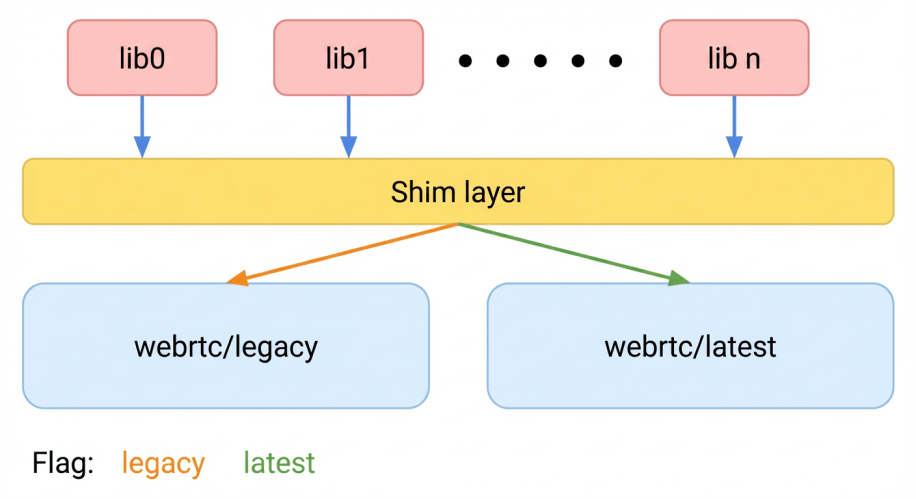
The key to safe migration is running two versions of WebRTC in the same application – your legacy fork and the clean upstream version with your customizations applied as thin wrappers. This dual-stack approach allows A/B comparison without disrupting current users.
- Identify modular boundaries: Separate your custom code (e.g., custom encoder, network adaptation) into plugins or interfaces that can be swapped.
- Create a version abstraction layer: Define a common API that both the legacy and new stacks implement. Use dependency injection or factory patterns to instantiate the right version at runtime.
- Support dynamic switching: Build a configuration mechanism (e.g., remote config flags) to select which stack a user or session uses. This enables gradual rollout and rollback.
Step 3: Solve Static Linking Collisions (ODR Violation)
Statically linking two versions of WebRTC into the same binary causes symbol conflicts due to the C++ One Definition Rule. Meta solved this by:
- Using namespacing and symbol hiding: Encapsulate one version in a separate namespace (e.g.,
webrtc_legacy) and use__attribute__((visibility("hidden")))or compiler flags to prevent symbol export. - Isolating translation units: Build each WebRTC version as a separate static library with unique prefix/suffix on symbols. Use
objcopyor linker scripts to transform symbols before final linking. - Employing wrapper objects: Create C-style interface wrappers that act as bridges, converting between versions’ data structures. This ensures no direct dependency on internal symbols from both versions.
Test the dual-link build early to catch ODR violations. Use a linker map to verify no duplicate symbols exist.
Step 4: Establish an A/B Testing Framework
With both stacks coexisting, you need infrastructure to measure the impact of upstream changes on your specific use cases.
- Define key metrics: End-to-end latency, bitrate stability, call establishment time, crash rate, and battery drain.
- Implement routing logic: Use a deterministic hashing function (e.g., based on user ID) to assign users to control (legacy) or treatment (new) groups. Ensure no session switching mid-call to avoid glitches.
- Logging and telemetry: Add detailed logs that record which version handled a call, along with performance counters. Aggregate data to a centralized dashboard.
Step 5: Continuous Upgrade Workflow
The goal is to never fall behind upstream again. Automate the process of merging new releases.
- Set up a nightly integration pipeline: Fetch the latest WebRTC commit and attempt to merge it into your new-stack codebase. Use git cherry-pick for your custom patches, with automatic conflict detection.
- Run A/B tests on each merge: Deploy the new stack to a small percentage of users (e.g., 1%) and monitor for regressions over a week.
- Gradual rollout: If no regressions, increase the rollout percentage. Use canary releases (internal employees, then external beta users) before full production.
Document every upgrade in a changelog that maps upstream changes to your use case impact. This transparency helps stakeholders understand risk.
Step 6: Migrate Use Cases One by One
You do not have to switch all 50+ uses at once. Prioritize by risk and complexity.
- Start with low-risk use cases: For example, video encoding for low-resolution calls or audio-only chats.
- Enable A/B for each case: Use the framework from Step 4 to validate that the new stack matches or exceeds the legacy fork for that specific scenario.
- Retire legacy components: Once a use case is proven, remove the legacy code path. Keep the old fork available as a fallback for a short period.
Meta did this over several years, gradually moving applications like Messenger, Instagram, and VR casting, each with its own timeline. This incremental approach minimizes risk and allows teams to learn from each migration.
Step 7: Monitor and Optimize
After migration, the work isn't over. Continuously improve the new WebRTC stack.
- Track binary size: Upstream WebRTC may add new features; ensure your customizations don't bloat the final binary. Use size-diff tools per release.
- Benchmark performance: Run automated benchmarks for CPU usage, memory, and latency. Compare against your legacy baseline.
- Patch upstream: Contribute your generic improvements back to the open-source project, reducing future merge conflicts.
Tips for Success
- Invest in testing infrastructure early: Without reliable A/B testing, you cannot safely upgrade. Meta found that a robust dual-stack setup was worth the initial effort.
- Don't ignore the linker: ODR violations will cause inexplicable crashes. Validate the dual-link solution on multiple platforms (Android, iOS, desktop) before scaling.
- Communicate across teams: Each use case may have unique requirements. Hold cross-team reviews to ensure all custom features are accounted for in the new stack.
- Accept incremental progress: Escaping the fork took Meta years. Celebrate small wins – migrating even 10 use cases is a major step.
- Document the architecture: Create a clear diagram of your dual-stack design, including symbol isolation and A/B routing. This aids new engineers and future audits.
By following these steps, your organization can break free from the forking cycle, continuously benefit from upstream improvements, and maintain the performance edge your users demand.